This article first published Oct. 29, 2026 in Christianity Today Magazine.
When Tennessee redistricted its Nashville metropolitan area and split Shelby County, home to majority-Black Memphis, into three congressional districts earlier this year, Jefferson Street Missionary Baptist Church knew the changes would affect its congregants.
Located in Nashville, the predominately Black church hosts year-round courses that teach congregants about voting and civics. Community organizations teach weekday workshops on ballot measures and proposed amendments to the state’s constitution. When new members join, the church gives them a voter registration application as part of their welcome packet. It also requires prospective leaders to be registered voters before assuming their role.
Jefferson Street’s politically active streak was kicked into hyperdrive after Tennessee’s legislature redrew the state’s voting maps in May to favor Republicans and eliminate one Democratic, Black-majority district.
“The feeling, for the constituents and the community I serve, is one that is alarmed … and deeply concerned about what is going on,” said Aaron Marble, the church’s senior pastor.
The change in Tennessee followed a Supreme Court decision that restricted state lawmakers from taking race into account when drawing districts that allow nonwhite voters to elect their preferred candidates—a practice that was used for decades to boost minority representation in Washington. The ruling weakened the Voting Rights Act of 1964 and set off a fresh wave of redistricting efforts in the South, including in Alabama and Louisiana, that eliminated or split predominantly Black districts.
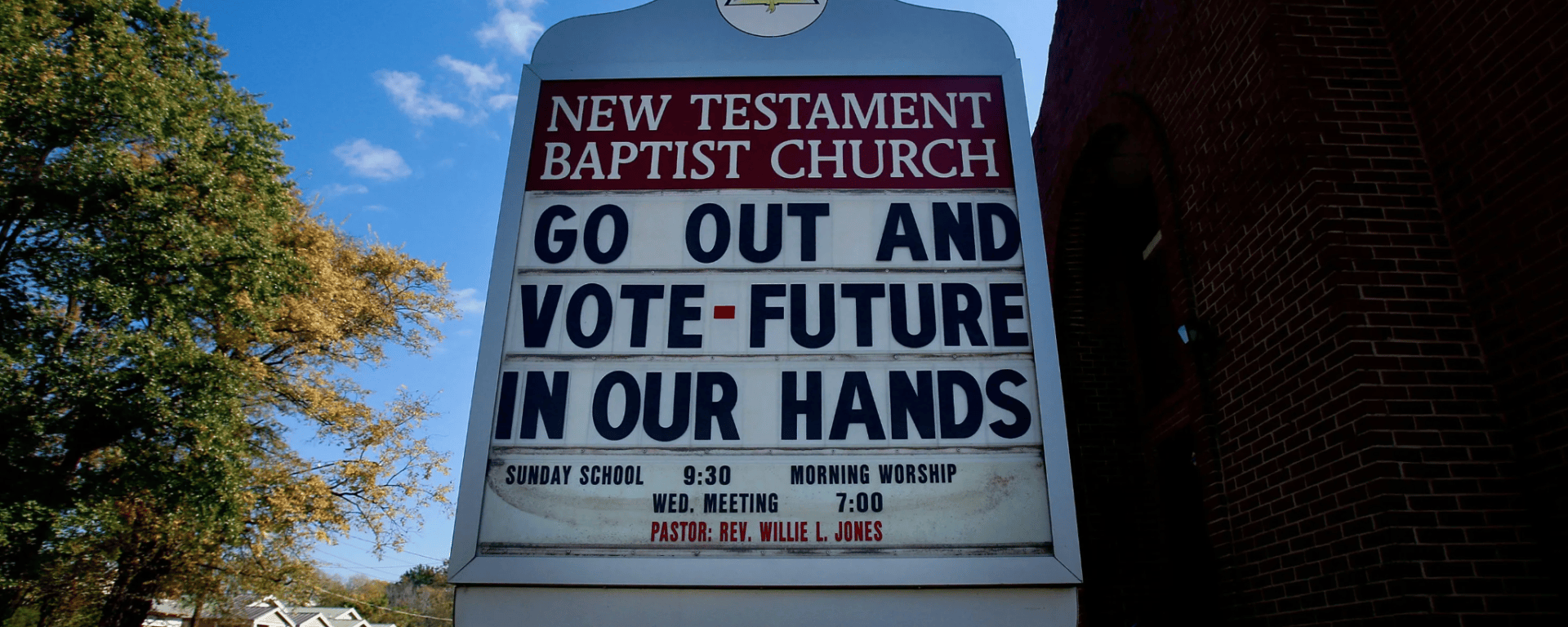
Black churches, which historically served as gathering spots for civil rights activism, remain some of the most politically active congregations in the US. And like Jefferson Street, many of them have used different strategies to engage voters amid the shakeup.
Church leaders have set up teams to register and encourage voters, invited politicians to speak to congregants, and launched a national index where voters can assess candidates through the lens of social justice. The traditionally Democratic voting bloc they shepherd is expected to back left-leaning candidates come November 3. According to the Pew Research Center, roughly three quarters of Black protestants plan to vote for a Democrat next week.
On election day, Jefferson Street will be a local gathering spot for vans, buses, and taxis picking up voters who need rides to polling sites. People will also gather at the church to make last-minute calls to unlikely voters in Nashville and encourage them to cast a ballot.
Marble said Jefferson Street invites candidates to speak at its Sunday services, but usually only Democrats accept. The church doubled down on giving candidates time during services this year so congregants can receive information they might not otherwise get, he said.
“You may miss ads and younger folk tend not to check their mail like older folk,” Marble added. “That face time on Sunday morning is still very meaningful engagement with candidates.”
But some of these practices—such as inviting candidates to speak at services—goes too far for some Christians, including those who support the Black church’s legacy of political involvement.
“I don’t ever want the church to become the arm, or an agent, of a particular party,” said Justin Giboney, president of the And Campaign, a nonpartisan Christian civic organization. “That compromises our moral authority.”
Giboney noted he supports church-led voter registration drives and Black churches’ “Souls to the Polls” efforts. But he said churches should tactfully discuss issues like equality, justice, poverty, and health care without championing specific political parties and while avoiding partisan language. He prefers when references to Bible stories or themes anchor a message on a particular topic. “There should be a distinction,” Giboney said, between how churches and partisans talk about issues.
Although Black protestants typically back Democrats, there are some prominent leaders on the other side of the political aisle.
Patrick Wooden, Sr., a Church of God in Christ (COGIC) bishop who pastors a church in Raleigh, North Carolina, recently encouraged people to vote in line with their biblical values while referencing various Democratic party positions he would never support.
“Vote your values,” Wooden told viewers on his YouTube channel. “Never be the person who prays one way and votes another.”
COGIC, the largest Pentecostal denomination in the US, launched a national project in October requiring local churches to establish a committee that maximizes voter registrations and mobilizes congregants.
As part of that project, Citadel of Deliverance COGIC, a Memphis-based congregation that sees about 1,000 attendees on Sundays, has been registering voters and hosting weekly civics workshops in partnership with external organizations.
Due to the recent redistricting, church members at Citadel are now part of districts that stretch 200 miles across poor, rich, urban and rural counties.
“That causes major issues in terms of compatibility” because those communities may have diverging needs, said Linwood Dillard II, a COGIC bishop who leads the church and oversees other congregations in Tennessee. Whoever ends up representing those districts, Dillard said, will have to be “very creative to adequately represent the interests of the entire area.”
The gerrymandering battle impacting voters extends beyond the South.
The tit for tat began last year after President Donald Trump successfully urged Texas lawmakers to redraw the state’s congressional map to benefit Republicans in the midterms.
Democrats responded by filing lawsuits intended to overturn or block maps favorable to Republicans, and redrew the voting map in California to give their party a better chance of flipping more seats.
Nationally, federal law prohibits churches from endorsing political candidates. The Trump administration and conservative Christian groups have been fighting in court to change those rules—a move that has been tepidly supported by some Black pastors and opposed by others.
Erika Crawford, an African Methodist Episcopal (AME) bishop who oversees churches across Louisiana and Mississippi, said this year, the denomination has been encouraging congregants to vote early and arrive at polls with a photo ID.
In Mississippi, church leaders have continued to partner with VoteRiders to help would-be voters secure the picture IDs required to cast a ballot.
Crawford said the AME has also been hosting voter registration drives in nearby Louisiana, where lawmakers redrew the state’s voting map in May and eliminated one of two majority-Black districts.
Furthermore, the denomination is encouraging congregants to use an AI-powered search tool that rates candidates on a social justice scorecard, and urging members to take four people with them to vote as part of an “Arrive with Five” initiative.
The Christian Methodist Episcopal Church (CME), a historically Black denomination that claims 1.2 million members, has a similar initiative of its own and what it calls “1,000 Marches to the Polls” (a congregant vehicle heading to the polls with five voters is considered one march).
Clarence K. Heath, a CME bishop who oversees churches across Alabama and Florida, said the congregations under his watch have been trying to energize registered voters who might be apathetic through personal, one-on-one, interactions.
CME churches will be bussing locals to the polls on election day, including in Alabama, where congregants are voting under a new map that has given Republicans an edge by diluting the Black vote. Some of those churches are planning to gather voters and make election day more festive by honking car horns, playing music, and waving flags as they head to the polls.
The church has to “make sure that we sound the alarm and encourage people without having the spirit of anger [and] hostility,” said Heath, who lives in Birmingham. It should encourage people “to participate in the process, believing that our presence, our voice, does count and it does matter.”
Across town from Citadel in Memphis, the predominantly Black Mississippi Boulevard Christian Church has spent the past few months sending nonpartisan mailers to locals reminding them to vote. Members have hosted weekly phone banks and knocked on doors. The church, whose two locations are now in different voting districts, has also hosted five candidate forums that have drawn 1,000 attendees.
“Our goal is to make sure many people are informed and activating their right to vote,” said Lawrence Turner, Mississippi Boulevard’s senior pastor.
The three Tennessee leaders—Marble, Turner, and Dillard—said they hope the winning candidates would address issues that matter to people and actually deliver on campaign promises.
Affordability concerns are especially pertinent for Turner and Dillard: Their churches run pantries that provide up to two weeks of food every month to more than 1,500 households, nearly double the demand from February 2025.


